
Block tumor repair and reduce immune exclusion.
Neutralising CXCL12 is intended to interrupt signals used by tumors to restore blood supply after radiotherapy and prevent immune cells from reaching the tumor.
TME Pharma’s assets neutralize the chemokines CXCL12 and CCL2 which drive pathological tissue repair, fibrosis and immune suppression, creating the potential to improve the effect of established therapies.
Chemokines act like location-specific signals in the body. Tumors can exploit these signals to recruit supportive cells, restore blood supply after treatment and limit effective immune attack.
The same signalling can go wrong outside oncology. In chronic inflammatory and fibrotic conditions, including diseases of the eye, CCL2 and related chemokines recruit monocytes and macrophages that sustain inflammation, promote scarring and suppress protective immune responses.
TME Pharma’s compounds are intended to remove selected signals from that environment.
Neutralising CXCL12 is intended to interrupt signals used by tumors to restore blood supply after radiotherapy and prevent immune cells from reaching the tumor.
Neutralising CCL2 and closely related chemokines creates a potential route to well-tolerated anti-fibrotic treatments.
NOX-A12 and NOX-E36 are PEGylated L-stereoisomer RNA aptamers. Their mirror-image configuration is naturally resistant to nuclease degradation and provides a large interaction surface for binding their chemokine targets.
The platform has produced clinical-stage compounds with established human safety experience and distinct opportunities for partnership-led development.
TME Pharma is focused on advancing its therapeutic candidates through partnerships to demonstrate their potential to improve outcomes in areas of high unmet medical need.
NOX-A12, the lead asset, is in mid-stage clinical development as a combination therapy for glioblastoma, where its impact on the tumor microenvironment is intended to enhance anti-cancer treatments without adding significant side effects. Clinical development plans also exist in pancreatic cancer, where promising results have been reported.
NOX-E36 has demonstrated potential to address fibrosis and inflammation, leading to its evaluation in ophthalmic diseases with a need for well-tolerated anti-fibrotic therapies. Exploratory clinical studies established activity on the biological target and a human safety profile.
Olaptesed pegol
A clinical-stage CXCL12 inhibitor designed to block tumor repair and reduce immune exclusion.
NOX-A12 is an injectable PEG-conjugated L-stereoisomer RNA aptamer that directly binds and neutralises CXCL12, preventing signalling through the CXCR4 and CXCR7 receptors and disrupting the chemokine gradient.
Limit the post-radiotherapy signals that help tumors restore blood vessels.
Change a tumor environment that can keep immune cells away.
Create the potential for established treatments to work more effectively.
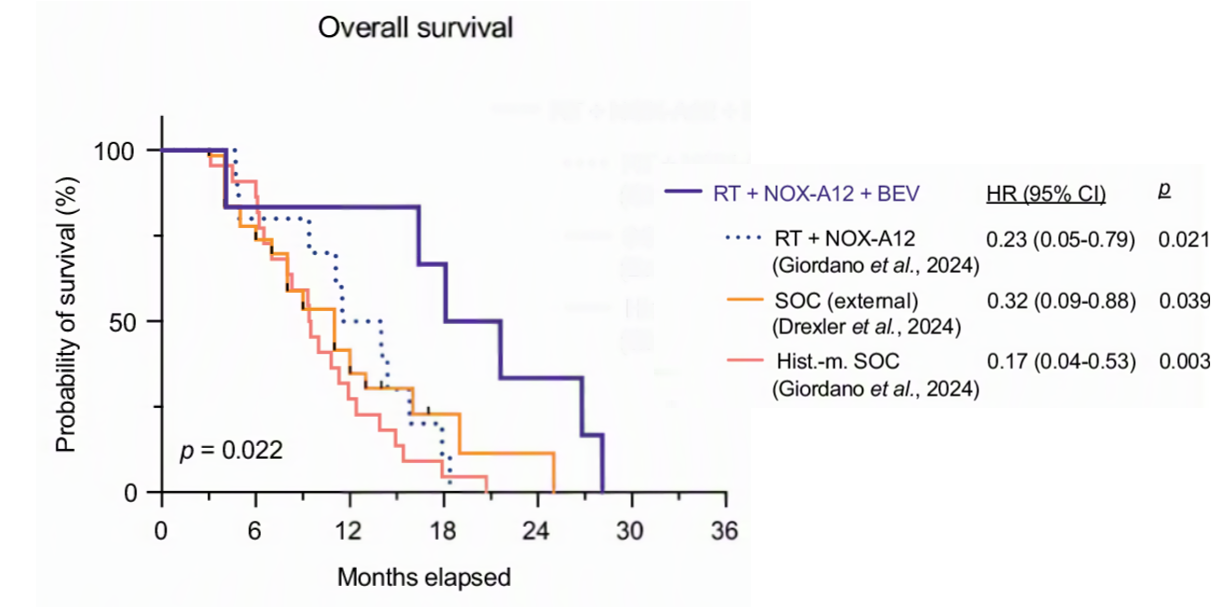
GLORIA is a Phase 1/2 study in glioblastoma patients resistant to standard chemotherapy, with an unmethylated MGMT promoter. It consists of a dose-escalation part with NOX-A12 plus radiotherapy and an expansion arm combining NOX-A12 with radiotherapy plus bevacizumab, a VEGF inhibitor.
Results reported to date from the six-patient NOX-A12, radiotherapy and anti-VEGF cohort.
Emapticap pegol
A clinical-stage CCL2 inhibitor with a human safety foundation and potential partnership opportunity in ophthalmology.
NOX-E36 (emapticap pegol) has completed Phase 1 and Phase 2 clinical studies, establishing its ability to target macrophages in a dose-dependent manner and its safety and tolerability profile in over 100 subjects. TME Pharma has been evaluating an opportunity for development of NOX-E36 in eye diseases with a high need for well-tolerated therapies with anti-fibrotic effect. The anti-fibrotic mode of action has already been demonstrated in relevant animal models.
NOX-E36 is an injectable PEGylated L-stereoisomer RNA aptamer conjugated to 40kDa PEG that directly binds and neutralises the human chemokine CCL2, also called Monocyte Chemoattractant Protein-1, as well as three highly related chemokines. CCL2 regulates migration and infiltration of monocytes and macrophages and recruits pro-fibrotic and immunosuppressive cell populations of the innate immune system.
The publications in this section are provided for historical purposes only. The views expressed are those of their respective authors and do not reflect the views of TME Pharma. TME Pharma disavows any obligation to update or correct the information contained in these publications.